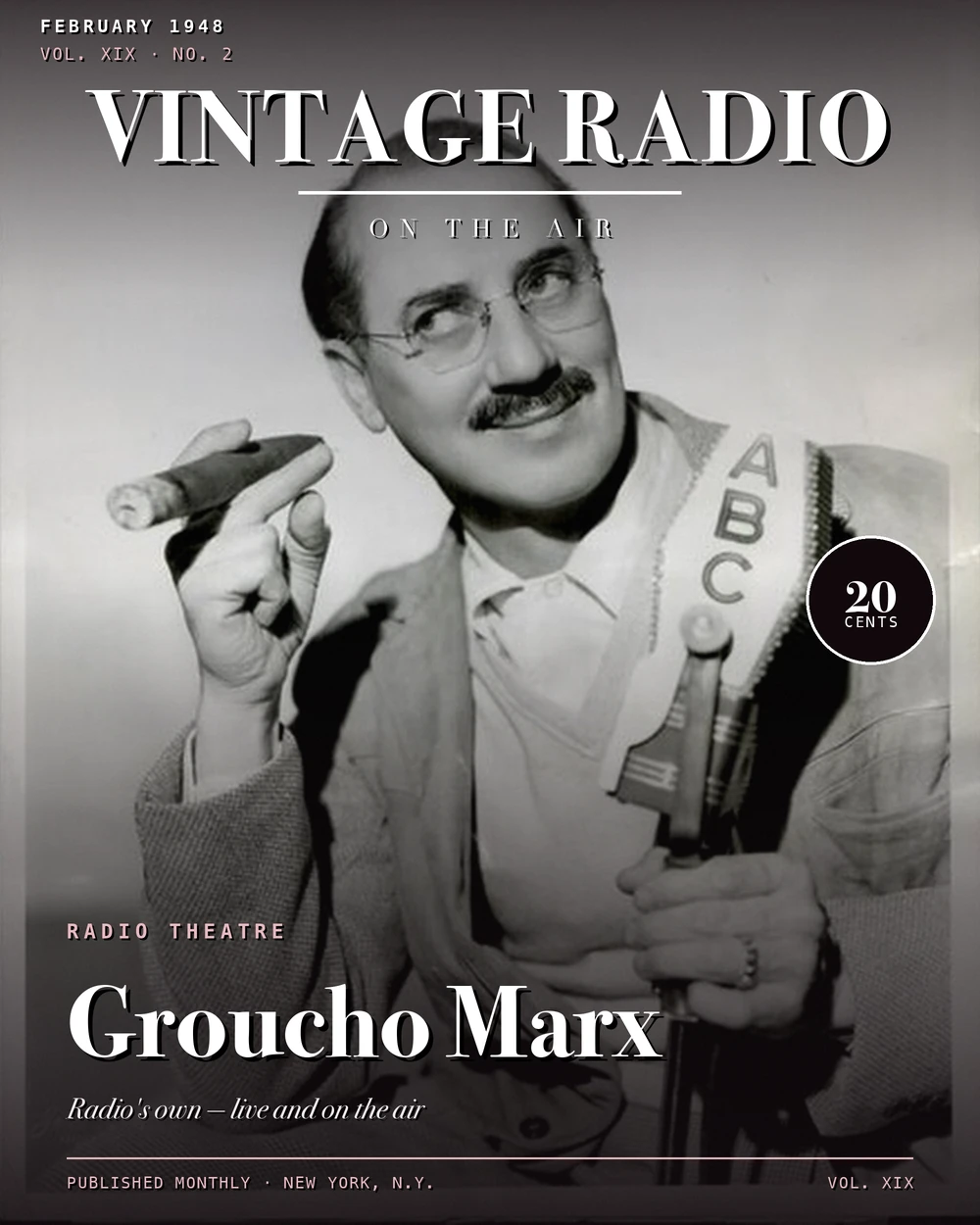
Groucho Marx
The Show That Let Groucho Be Groucho
The program most people know as The Groucho Marx Show was really called You Bet Your Life, and the distinction matters. The quiz format was almost beside the point — a scaffolding that gave Groucho somewhere to stand while he talked to strangers and made them, and the audience, laugh. Producer John Guedel dreamed up the concept after watching Groucho ad-lib his way through a guest appearance on a Bob Hope broadcast in 1947. Guedel recognized that the best thing Groucho could do on radio was exactly what he did in conversation: riff, probe, and deflate with perfect timing. You Bet Your Life debuted on ABC Radio on October 27, 1947, moved to CBS Radio on October 5, 1949, and then crossed to NBC Television and NBC Radio simultaneously on October 4, 1950.
The show was prerecorded before a studio audience and then edited from roughly an hour down to a tight 30-minute broadcast. That setup was the secret weapon. Groucho could go anywhere in the conversation — and he did — knowing that anything genuinely unsuitable would land on the cutting room floor. The result sounded spontaneous because it mostly was, and polished because editors had done their work. Announcer and sidekick George Fenneman completed the picture, introducing Groucho each week with "Here he is, the one, the only… GROUCHO!" and serving as a warm, patient foil for whatever Groucho chose to throw at him.
Before You Bet Your Life
Groucho's path to radio success was not a straight line. He was born Julius Henry Marx on October 2, 1890, in Manhattan, and entered show business at fifteen as a singer in the Leroy Trio. His brothers — Chico, Harpo, Gummo, and Zeppo — joined the act over the years, and the Marx Brothers eventually became a Broadway phenomenon with I'll Say She Is (1924), The Cocoanuts (1925), and Animal Crackers (1928) before decamping to Hollywood for thirteen feature films.
Radio, though, was a tougher fit. Groucho co-starred with Chico in Flywheel, Shyster and Flywheel on NBC Blue from 1932 to 1933, twenty-six episodes in all. A decade later he hosted Blue Ribbon Town on CBS (1943–1944), sponsored by Pabst Blue Ribbon beer, and it went nowhere. The problem wasn't talent — it was format. The Marx Brothers' comedy was physical and anarchic, and squeezing it into a scripted radio program just produced something that felt constrained. You Bet Your Life worked because it stopped trying to script Groucho and simply pointed him at real people.
Recognition and a Few Complications
The industry noticed quickly. You Bet Your Life received a Peabody Award in 1948, with the citation naming Groucho "the Dean of all wise-crackers in this country." When the show expanded to television, Groucho won an Emmy for his work in the 1950–1951 season. The program was also a trailblazer in the business sense: it was the first network television series to air summer reruns, packaged as The Best of Groucho, and the first game show to have its reruns syndicated. The show was inducted into the Radio Hall of Fame in 1988.
Not everything ran smoothly. In 1953, the show's musical director Jerry Fielding was called before the House Un-American Activities Committee, creating a controversy that touched the production. On the sponsorship side, the show began with Elgin American and later brought in Chrysler/DeSoto automobiles as a major backer — Groucho himself delivered the closing DeSoto advertisement each episode, in his own fashion.
How It Ended, and What Came After
The last radio episode of You Bet Your Life aired on June 10, 1960. The television version ran one more year under the retitled The Groucho Show, ending in 1961. By then Groucho had been in front of audiences for more than half a century. He wrote his autobiography Groucho and Me in 1959, followed by The Groucho Letters in 1967, and later donated his correspondence to the Library of Congress. In 1972 he performed a live one-man show at Carnegie Hall, and in 1974 he received a special Academy Award honoring the achievements of the Marx Brothers. He died on August 19, 1977.
The greasepaint mustache, the cigar, the stooped walk, the eyebrows — all of it started in vaudeville. When You Bet Your Life moved to television, he traded the greasepaint for a real mustache, but the persona beneath it stayed exactly the same: a man who found the gap between what people said and what they meant, and stepped into it with a well-timed line.